LinkBikeNet 0.10.0 documentation
The Python package linkbikenet finds links between the disconnected components in a city’s bicycle network. You can download street and bike network data with a single line of code, simulate different bicycle network linking scenarios, and export and plot the resulting prioritized linking steps. It is hosted on Github, part of BikeNetKit.
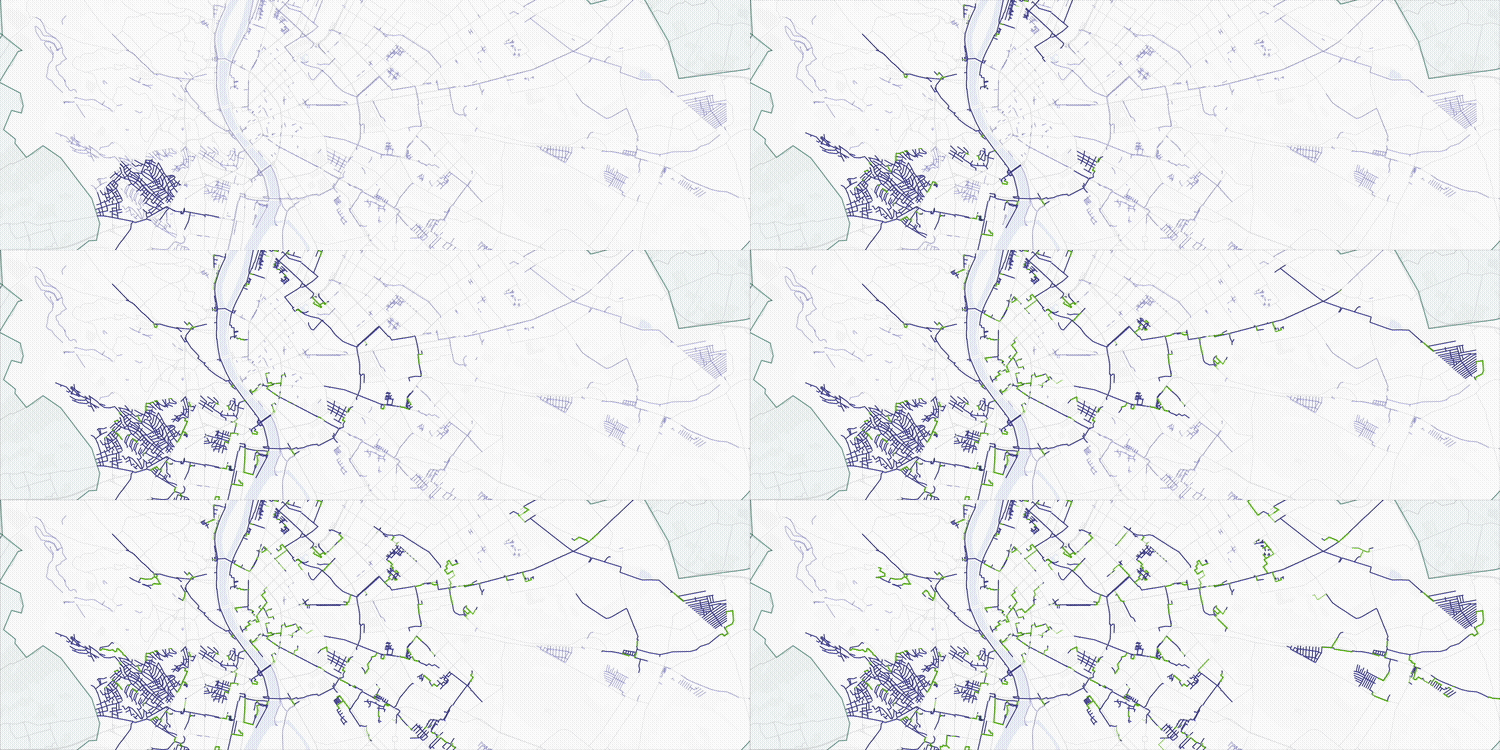
LinkBikeNet is a decision support tool for urban planners. It is also useful for proactive citizens to help inform their city about data-driven improvements, and it aims to foster research on bicycle networks.
When to use
LinkBikeNet works well for cities that have some bicycle infrastructure in the form of disconnected components. This is the case for most cities in Europe. Recommended example cities to link components: Budapest, Dublin, Tirana
For alternative approaches, consider using FixBikeNet or extending the existing network with GrowBikeNet.
Setup and use
To set up LinkBikeNet, see the Installation page. To use LinkBikeNet, the Getting started page is a good place to start, which also explains how the package works in detail. For technical documentation, consult the User reference. See also our Frequently Asked Questions.
Origin
The source code builds on the code from the research paper Data-driven strategies for optimal bicycle network growth.
How to cite
If you use LinkBikeNet in your research, please cite the paper:
L.G. Natera Orozco, F. Battiston, G. Iñiguez, M. Szell. Data-driven strategies for optimal bicycle network growth. Royal Society Open Science 7:201130 (2020)
Contributing
If you want to contribute to the development of LinkBikeNet, please read the CONTRIBUTING.md file.
Supported by
Development of BikeNetKit/LinkBikeNet was supported by the Innovation Fund Denmark and the EU HORIZON grant JUST STREETS.



Developed by